← Species Reference
Case Study

Tokyo Office Atrium
Lucidophyllous Forest Installation

Daylight analysis, species viability mapping, and planting recommendations for an indoor (shining-leaf forest) within a commercial office atrium.
Climate — Tokyo Chofu TMYx Atrium — ~800 m² planting zone 19 Species — 5 Forest Layers
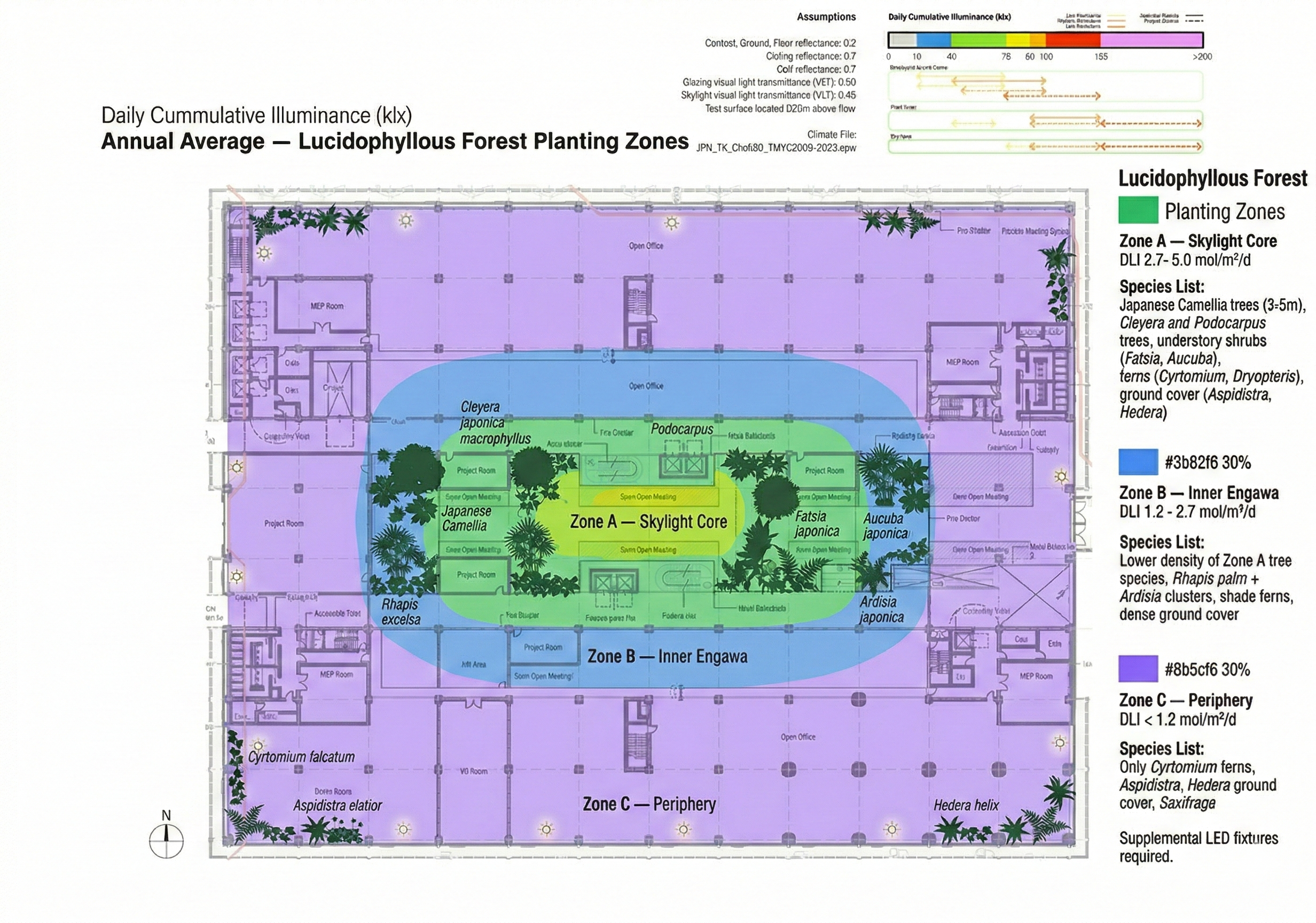
Lucidophyllous Forest Planting Zones — Zone A (Skylight Core), Zone B (Inner Engawa), Zone C (Periphery) with species placement

Planting zone overlay on annual average illuminance map — generated with AI visualization
What is a Lucidophyllous Forest?

From Latin lucidus (shiny) + Greek phyllon (leaf) — a warm-temperate evergreen broadleaf forest defined by thick, glossy, wax-coated leaves.

— Shōyō-jurin

Literally “shining-leaf tree forest.” These forests are the climax vegetation of lowland and foothill southwestern Japan, extending from Kyushu through Shikoku to the southern Kantō plain. Dominated by evergreen oaks (Quercus), chinquapins (Castanopsis), and laurels (Machilus, Cinnamomum), they form a densely layered canopy that transmits only 2.5–5% of sunlight to the forest floor. The flora comprises approximately 1,008 species including ferns, forest-floor herbs, and epiphytes.

— Engawa

The atrium design uses “engawa” — the traditional Japanese covered veranda that serves as a liminal space between inside and outside. In the original architecture, one sits at the edge and contemplates the garden. Here, the engawa zone transitions from office floor to forest core: light levels, materiality, and planting density all shift gradually, echoing the traditional house–garden relationship.

Forest Layers
5

Canopy • Sub-canopy • Understory • Ferns • Ground cover

Species in Study
19

From the Japanese lucidophyllous forest species reference

Natural Understory Light
2–5%

Of full sunlight reaches the forest floor — DLI 1–4 mol/m²/d

Indoor Precedent
First

No large-scale indoor lucidophyllous forest installation exists globally

Seasonal Sunlight Analysis

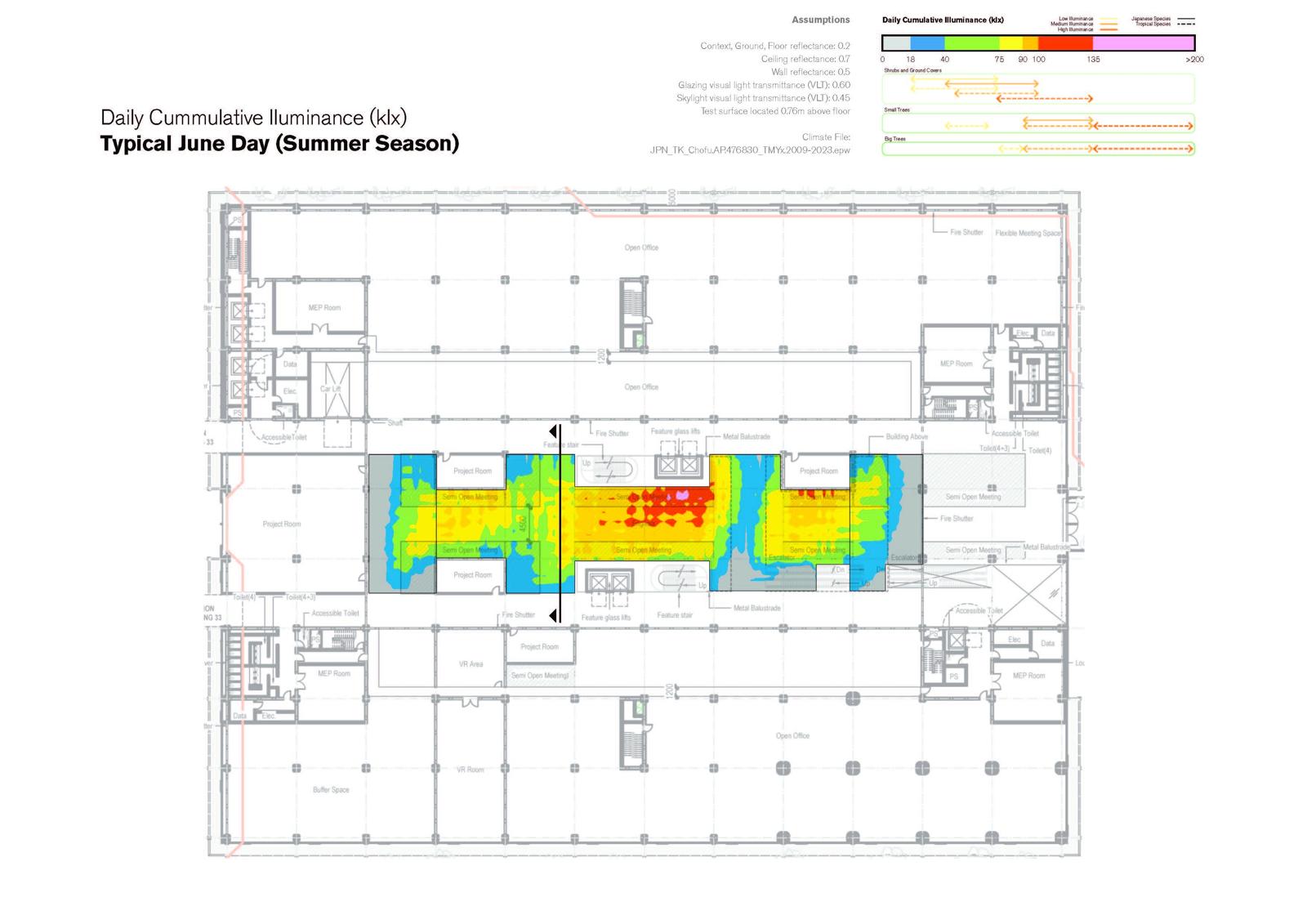
Daily Cumulative Illuminance (klxh) measured at 0.76m above floor. Glazing VLT 0.60, skylight VLT 0.45. Climate data: Tokyo Chofu TMYx 2009–2023.

Dec — Feb
Mar — May
Jun — Aug
Sep — Nov
Summer (June) illuminance map
Best Case

Summer — Typical June Day

Center: 100–200+ klxh (DLI 6.7–13+). Engawa: 40–100 klxh (DLI 2.7–6.7). Edges: 18–40 klxh. Red/orange hotspots directly under skylights.

Mid-season (September) illuminance map
Mid-Season

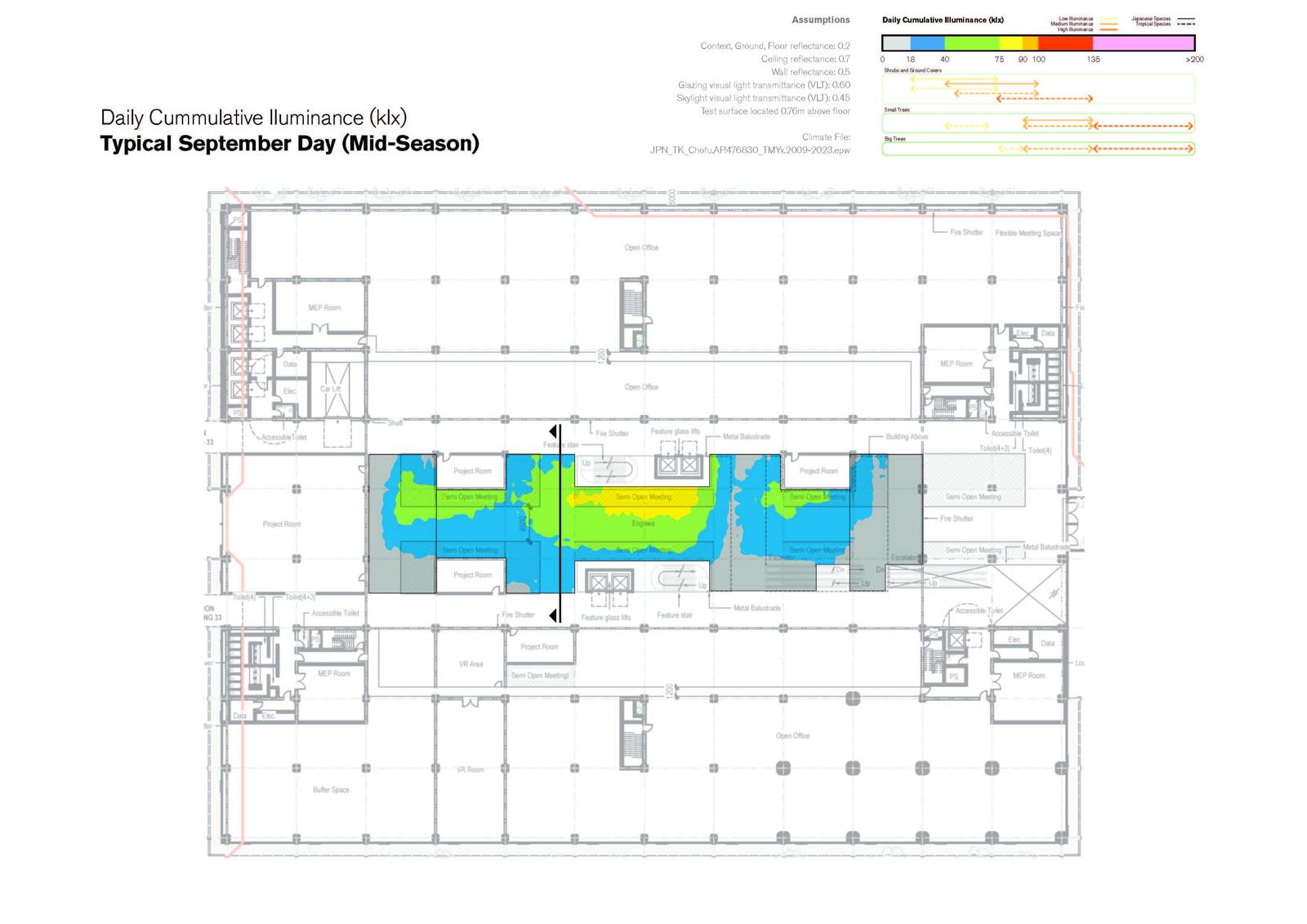
Mid-Season — Typical September Day

Center: 40–75 klxh (DLI 2.7–5.0). Engawa: 18–40 klxh (DLI 1.2–2.7). Green-yellow patches under skylights, blue-cyan spreading.

Annual average illuminance map
Design Reference

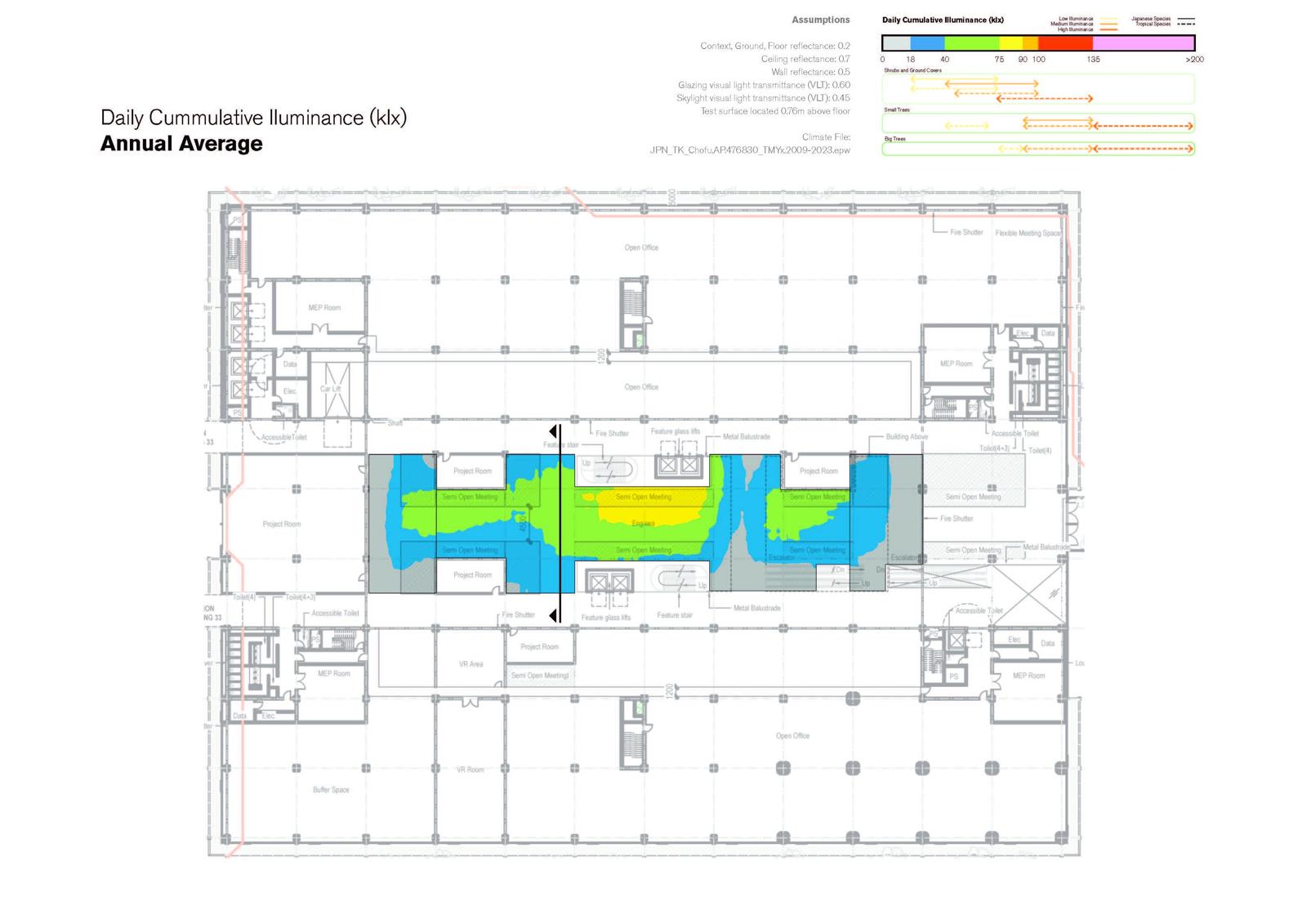
Annual Average

Center: 40–75 klxh (DLI 2.7–5.0). Inner: 18–40 klxh (DLI 1.2–2.7). Edges: <18 klxh (<1.2 DLI). This is the baseline for planting decisions.

Winter (December) illuminance map
Design Constraint

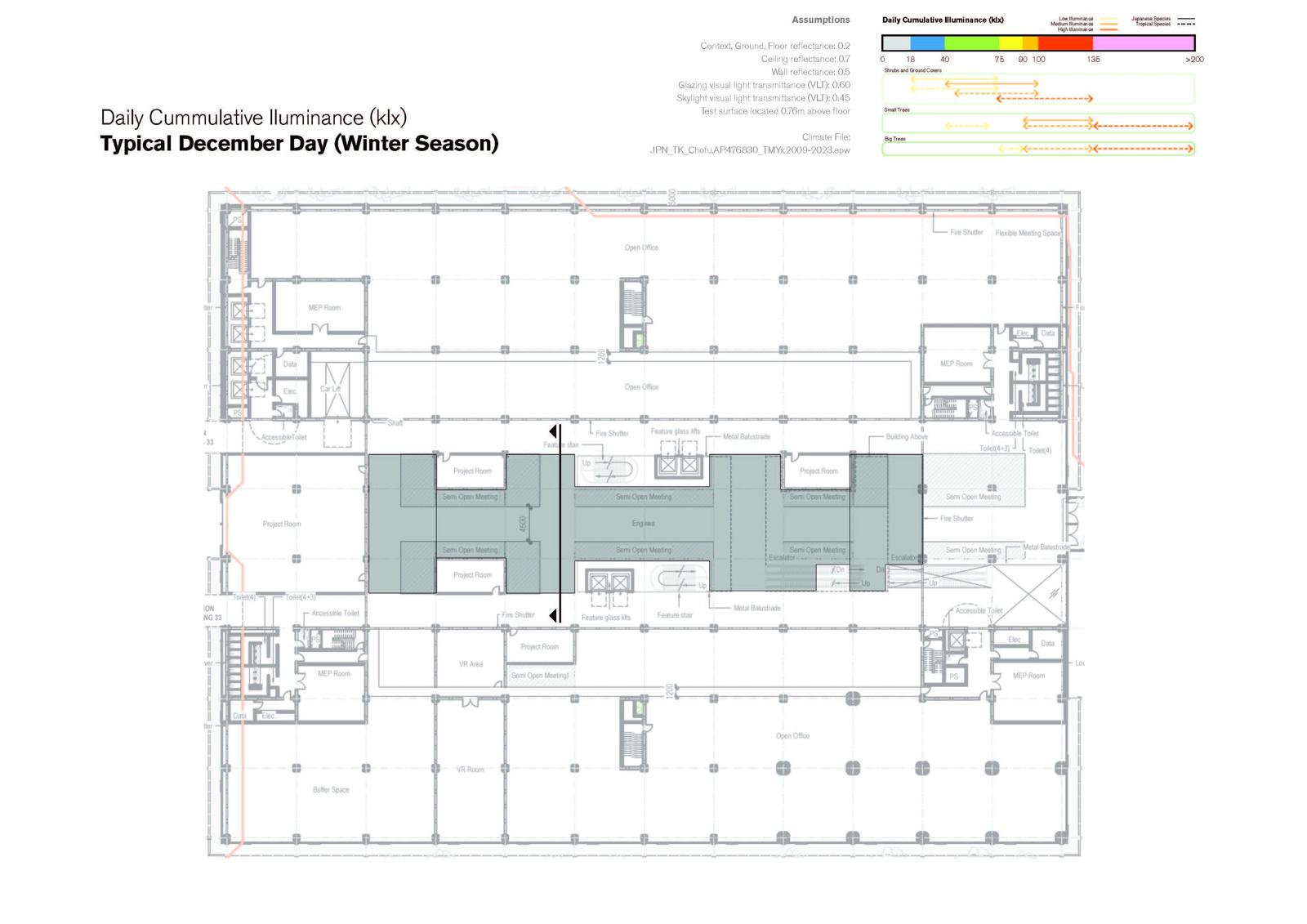
Winter — Typical December Day

Near-zero everywhere. The entire atrium drops below survival thresholds for all species. Supplemental lighting is not optional — it is the entire light budget for 3 months.

Three Planting Zones

Derived from annual average illuminance. Winter light is near-zero everywhere — supplemental lighting targets are based on bridging the winter gap entirely.

Zone Location Annual Avg (klxh) Annual DLI Supplemental Target Required PPFD (15h)
A — Skylight Core Directly under central skylights 40–75 2.7–5.0 mol/m²/d DLI 3–5 (winter) 56–93 µmol/m²/s
B — Inner Engawa Engawa corridor, semi-open meeting edges 18–40 1.2–2.7 mol/m²/d DLI 2–3 (winter) 37–56 µmol/m²/s
C — Periphery Edges near project rooms <18 <1.2 mol/m²/d DLI 1–2 (winter) 19–37 µmol/m²/s

Viability by Zone

Cross-referencing each species’ DLI minimum against annual average conditions per zone. All zones require supplemental lighting in winter.

Species Layer DLI Min Zone A Zone B Zone C Action
Daphniphyllum macropodum Sub-canopy 2.0 +light Keep
Distylium racemosum Sub-canopy 2.0 +light Keep
Neolitsea sericea Sub-canopy 3.0 +light × Keep (Zone A)
Ilex rotunda Sub-canopy 3.0 +light × Keep (Zone A)
Ilex integra Sub-canopy 3.0 +light × Keep (Zone A)
Fatsia japonica Understory 2.0 +light Keep
Aucuba japonica Understory 2.0 +light Keep
Sarcandra glabra Understory 2.0 +light Keep
Ardisia sieboldii Understory 3.0 +light × Keep (Zone A–B)
Cyrtomium falcatum Ferns 1.0 Keep
Dryopteris erythrosora Ferns 2.0 +light Keep
Polystichum polyblepharum Ferns 2.0 +light Keep
Coniogramme japonica Ferns 2.0 +light Keep
Aspidistra elatior Ground 0.5 Keep
Hedera rhombea Ground 0.5 Keep
Carex morrowii Ground 1.5 +light Keep
Ophiopogon japonicus Ground 1.5 +light Keep
Ardisia japonica Ground 2.0 +light Keep
Liriope muscari Ground 2.0 +light Keep (monitor)

Viable on natural light  •  Marginal  •  +light Needs supplemental  •  × Not viable

Additional Recommended Species

Species with verified indoor performance that complement the core palette. These provide additional structural height, seasonal color, and ground cover options for the atrium design. All DLI values assume a 15-hour supplemental photoperiod.

Canopy Layer — indoor-scale tree options

Recommended

Camellia japonica

DLI Min
2.0–3.0
Indoor Height
2–5m
RH
50–70%
Temp
5–25°C
Native
Japan ✓
Zones
ABC
The quintessential Japanese shade tree. Dense, glossy evergreen foliage with spectacular winter/spring flowers. Thrives in the understory of natural lucidophyllous forest. Provides structural height while tolerating DLI 2–3. Culturally iconic — one of Japan’s most revered ornamental trees. High
Strong

Cleyera japonica

DLI Min
2.0–3.0
Indoor Height
2–4m
RH
50–70%
Temp
7–27°C
Native
Japan ✓
Zones
ABC
Sacred Shinto tree. Dense, glossy broadleaf foliage with reddish new growth — echoes the natural canopy’s aesthetic. Naturally grows in the sub-canopy of lucidophyllous forests. Culturally significant and excellent shade tolerance. Compact, manageable form indoors. High
Versatile

Podocarpus macrophyllus

DLI Min
2.0–3.0
Indoor Height
2–5m
RH
40–65%
Temp
7–30°C
Native
Japan ✓
Zones
ABC
Conifer with broadleaf appearance — long, dark, leathery leaves create a dense vertical silhouette. Dense dark needles create strong vertical structure. Extremely shade-tolerant and proven in commercial interiorscapes worldwide. Tolerates the widest RH range of any tree alternative. High
Accent

Eurya japonica

DLI Min
1.5–2.5
Indoor Height
1.5–3m
RH
50–70%
Temp
5–27°C
Native
Japan ✓
Zones
ABC
Small-leaved, densely branched evergreen — the “little Sakaki” of the lucidophyllous forest sub-canopy. Produces fragrant white flowers and black berries. One of the most shade-tolerant trees in the community. Dense canopy character at a manageable indoor scale. Medium

Understory Structure + Berry Accent

Structure

Rhapis excelsa

DLI Min
1.5
Size
1.5–2.5m
RH
35–60%
Temp
10–30°C
Native
S. China (Edo-era JP)
Zones
ABC
Bamboo-like vertical structure. Multiple slender stems with fan-shaped compound leaves create an airy, layered understory silhouette. Among the best palms for low-light interiorscapes (UF/IFAS). Does not provide red color — pair with Ardisia crenata. High
Berries

Ardisia crenata

DLI Min
2.0
Size
1.0–1.5m
RH
45–70%
Temp
7–27°C
Native
Japan ✓
Zones
ABC
Closest red-berry analog. Persistent bright red berry clusters in winter, glossy evergreen foliage. Culturally significant — traditional New Year plant (kadomatsu). Place in brighter zones (DLI 3+) for reliable berry production. Japanese native. Medium
Alternative

Aucuba japonica (female)

DLI Min
1.0–1.5
Size
1.0–1.5m
RH
35–65%
Temp
7–27°C
Native
Japan ✓
Zones
ABC
Dense, leathery evergreen with persistent red berries on female plants. Exceptional shade tolerance — thrived in Victorian-era “dark, cool rooms.” Use self-fertile ‘Rozannie’ cultivar to ensure berries. Green-leaved forms (avoid gold-variegated) maintain forest authenticity. Japanese native. Medium-High

Understory — Compact Evergreen + Fragrance

Recommended

Aucuba japonica (female)

DLI Min
1.0–1.5
Size
1.0–1.5m
RH
35–65%
Zones
ABC
Dense, compact, rounded evergreen with red berries and exceptional shade tolerance. Green-leaved cultivars for forest authenticity. Medium-High
Fragrance

Sarcococca confusa

DLI Min
1.0–1.5
Size
1.0–1.5m
RH
35–60%
Zones
ABC
Dense compact evergreen with glossy small leaves. Winter-fragrant white flowers (vanilla/honey). Black berries (not red). Tolerates “pollution, dry shade, and neglect.” Chinese native, established in Japanese gardens. Medium

Fern Layer — Bold Architectural Ferns

Recommended

Cyrtomium falcatum

DLI Min
1.0
Size
0.4–0.7m
RH
40–60%
Zones
ABC
“One of the easiest ferns to grow indoors.” Tolerates dry air, low light, and gas fumes better than any other fern. Bold, leathery, glossy pinnate fronds with architectural quality. Japanese native. High
Dramatic

Asplenium antiquum

DLI Min
1.2
Size
0.6–1.0m
RH
50–70%
Zones
ABC
Dramatic rosette of broad, undivided fronds with bold visual scale. Common in Japanese atrium plantings. The Japanese native species (not the tropical A. nidus). Needs slightly higher RH than Cyrtomium but well within humidified atrium range. Medium-High

Ground Cover — Spreading Mat Options

Recommended

Saxifraga stolonifera

DLI Min
1.2
Size
15–30cm × spreading
RH
40–70%
Zones
ABC
Low spreading mat with colored foliage. Heart-shaped leaves with silver veining and distinctive purple-red undersides. Spreads by stolons for even coverage. Japanese native with proven indoor performance. High
Dark Accent

Ophiopogon planiscapus ‘Nigrescens’

DLI Min
1.2
Size
15–25cm tufts
RH
35–60%
Zones
ABC
Near-black purple foliage — one of the deepest purples in the plant kingdom. Creates striking contrast against green companions. Produces lavender flower spikes and black berries. Japanese native cultivar. Medium

Supplemental Lighting Strategy

Supplemental lighting is survival-critical from November through February. The system must provide the entire plant light budget during winter while remaining invisible as “grow lights” to office occupants.

Spectrum

3500–4000K

Full-spectrum warm-white LED. High CRI for natural appearance. Optional deep-red 660nm channel for winter compensation in canopy zones.

  • No purple/pink grow light aesthetics
  • Indistinguishable from architectural ambient lighting
  • Separate horticultural and human ambient channels

Installed Load

~17 kW

Total installed electrical load for ~800 m² planting zone at full output. Equivalent to 20–30 office workstations.

  • Zone A (core): 4.5 kW — 93 µmol/m²/s
  • Zone B (engawa): 6.3 kW — 56 µmol/m²/s
  • Zone C (periphery): 5.9 kW — 37 µmol/m²/s

Annual Energy

~43 MWh

With seasonal dimming strategy. Full output Nov–Feb, 30–70% Mar–Apr/Oct–Nov, 0–30% May–Sep.

  • Year-round full output: ~91 MWh
  • Seasonal dimming (realistic): ~43 MWh
  • Annual cost: ~¥1.3M (~€8,000)

Control System

Auto-dim

PAR sensors at representative canopy and understory positions. Supplemental DLI = Target DLI − Measured Daylight DLI.

  • Independent intensity per zone (canopy, mid, floor)
  • Cloudy-day boost (like Amazon Spheres)
  • IP65+ fixtures for irrigation/humidity resistance

Fixture Integration

Layered

Three-layer system: concealed high-output bars above canopy, narrow-beam accent spots for tree crowns, understory bars in planter edges.

  • Top-light: linear LED bars in roof steel/catwalks
  • Crown: narrow-beam (15–40°) track projectors
  • Floor: mini-bars concealed in planter edges, railings

Maintenance

1–2 staff

Dedicated horticulturists for ongoing maintenance. Plant rotation contract recommended (Amazon Spheres model).

  • Weekly visual checks, fortnightly weeding
  • Monthly pruning, regular dust rinsing
  • Stressed specimens rotated to off-site nursery

Precedent Projects

No large-scale indoor lucidophyllous forest installation exists globally. These are the closest references — each contributing different lessons.

ACROS Fukuoka

Emilio Ambasz • 1995 • Fukuoka, Japan

5,400 m² terraced green roof with temperate Japanese species. Self-enriched from 76 to 120 species over 30 years through bird-dispersed seeds. The most relevant species palette precedent.

Lesson: Ecological succession is real — design for natural enrichment over decades.

Amazon Spheres

NBBJ • 2018 • Seattle, USA

~40,000 plants, 400+ species in glass domes. Custom LED system with 150+ photocell-controlled lights. Team of 6 horticulturists. Plant rotation with off-site greenhouses.

Lesson: Rotation contract is crucial — stressed plants swap to greenhouses for recovery.

Toranomon Hills Station Tower

Mori Building / Green Wise • 2023 • Tokyo

Native Japanese plants emphasizing seasonal change. Trees to second floor, shorter plants higher. ~7,800 m² total green area. Closest Tokyo precedent for atrium + Japanese planting integration.

Lesson: Green Wise (Tokyo) are the specialist firm for Japanese interior landscapes at this scale.

Hankook Technoplex

Foster + Partners • 2020 • Pangyo, South Korea

Indoor trees define breakout spaces on each level. Greenery travels to top of building around spiraling atrium. Digital Phyllotaxy art installation mimics tree canopy.

Lesson: Closest F+P precedent for atrium + planting integration in an Asian office tower.

Jewel Changi Airport

Safdie Architects • 2019 • Singapore

22,000 m² Forest Valley, 900+ trees, ~60,000 shrubs. Massive daylight via glass toroidal dome. ~30 gardeners for weekly maintenance. teamLab responsive forest lights.

Lesson: Scale of maintenance labor — ~30 gardeners for 22,000 m² suggests 1–2 for 800 m².

Azabudai Hills

Mori Building / Heatherwick Studio • 2023 • Tokyo

~24,000 m² green space, ~320 plant species. Demonstrates Tokyo market appetite for large-scale integrated green infrastructure in premium commercial developments.

Lesson: Premium Tokyo market supports this level of biophilic investment.